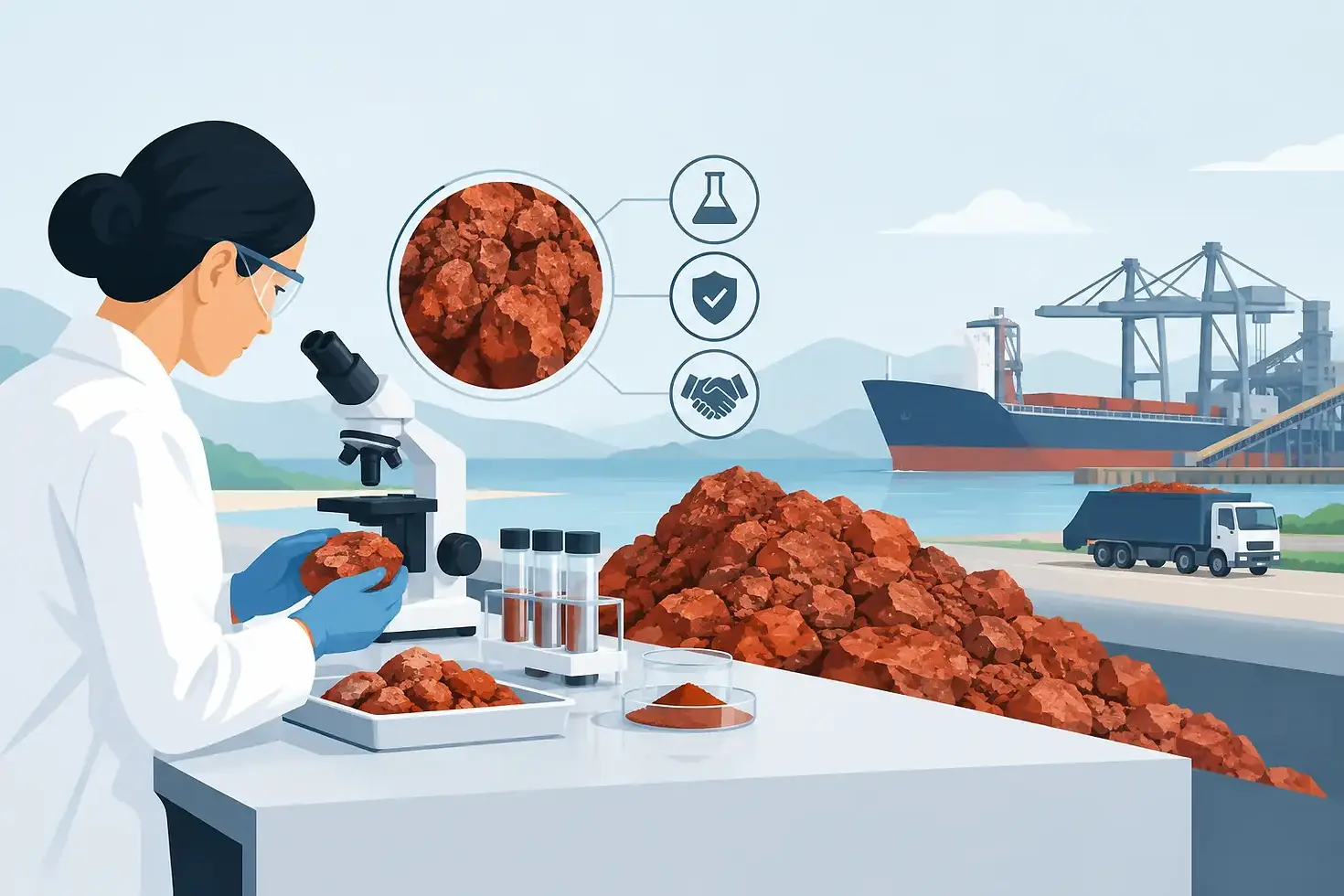
Bauxite Testing Review for Reliable Supply
A refinery does not purchase bauxite on an assay certificate alone. It purchases expected alumina recovery, process stability, shipping reliability, and confidence that the material loaded at port reflects the resource evaluated at mine. A rigorous bauxite testing review connects these requirements through a disciplined chain of sampling, laboratory analysis, quality assurance, and commercial interpretation.
For industrial buyers, investors, regulators, and logistics partners, testing is not a downstream administrative step. It is a core control point in the value chain. The quality of the data shapes mine planning, stockpile management, blending decisions, freight economics, refinery settings, and long-term supply commitments.
What a Bauxite Testing Review Must Establish
A meaningful review must answer more than whether a shipment meets a single headline grade. It should establish whether the testing program represents the orebody and the material actually delivered, whether the analytical methods are fit for purpose, and whether results are traceable across mining, processing, storage, and loading.
The first question is representativeness. Bauxite deposits can vary materially across benches, pits, and mining blocks. Alumina content, reactive silica, iron oxides, titanium dioxide, organic matter, moisture, and particle-size distribution may change over relatively short distances. A high-quality sample from the wrong location is still the wrong basis for a commercial decision.
The second question is consistency. Buyers need to understand not only average chemistry but also variability. A favorable annual average can conceal operational risk if monthly or shipment-level results fluctuate beyond refinery tolerances. Testing data should therefore be reviewed by mining zone, production period, stockpile, and cargo where applicable.
The third question is fitness for the intended refining route. Bauxite is not valued in isolation. Its value depends on how it performs in the Bayer process or another defined industrial pathway. Available alumina, reactive silica, alumina-to-silica ratio, impurities, and moisture all affect caustic soda consumption, red mud generation, digestion conditions, handling, and total refinery economics.
Sampling Determines the Value of Every Assay
Laboratory precision cannot correct poor sampling. The most advanced analytical equipment will only confirm the composition of the material submitted to it. That is why a testing review begins at the mine face and continues through preparation, storage, transport, and vessel loading.
Mine samples should be collected under a documented protocol that defines spacing, increment size, sample mass, compositing rules, labeling, and chain of custody. The protocol should reflect deposit geology and grade variability rather than simply follow a fixed routine. Higher variability requires more frequent sampling and a stronger reconciliation process between exploration data, grade-control results, and production outcomes.
At the production stage, stockpiles require particular attention. Blending can reduce variability and support a more stable export specification, but it can also obscure material movements if stockpile boundaries and reclaim sequences are not controlled. A review should verify how material is placed, sampled, reclaimed, and reconciled. It should also examine whether stockpile samples are representative of the final cargo profile.
Moisture is equally commercial. It affects dry-ton calculations, vessel payload planning, freight efficiency, material flow, and contractual settlement. Moisture testing needs clear procedures for sample sealing, timing, drying temperature, duplicate analysis, and reporting. In high-rainfall mining environments, delays between collection and testing can distort results if moisture control is weak.
Chemistry Must Be Read as Process Performance
A bauxite testing review should assess the relationship between analytical results and refining performance. Total alumina is an essential indicator, but it does not alone describe recoverable value. Available alumina under defined digestion conditions is often the more useful measure for evaluating process yield.
Reactive silica deserves close attention because it can consume caustic soda and increase desilication-product formation. Its effect depends on the refinery's operating conditions and feed blend. A buyer may accept a certain silica range when material is blended with complementary ores, yet find the same range unsuitable in a more constrained feed system. This is why product specifications should be interpreted in the context of a declared processing route rather than as generic market labels.
Iron oxides and titanium dioxide may not always be penalty elements at moderate levels, but they influence residue characteristics and can affect downstream operating choices. Organic carbon, sulfur, phosphorus, and other minor constituents can also become relevant depending on refinery configuration and environmental controls. A sound review considers these components proportionately, focusing on the parameters that materially affect the customer’s process and risk profile.
Particle size and clay content should not be treated as secondary concerns. Fine material can affect washing efficiency, stockpile drainage, dust management, slurry behavior, and cargo handling. Material with acceptable chemistry but difficult physical behavior can still introduce avoidable cost and disruption across the supply chain.
Analytical Quality Requires Independent Controls
A credible laboratory program combines appropriate methods with verifiable quality controls. X-ray fluorescence is widely used for routine elemental analysis, while wet chemical methods may be applied for available alumina and reactive silica under specified conditions. The critical issue is not selecting one method in isolation. It is ensuring that preparation, calibration, reporting, and verification are consistent with the commercial and technical purpose of the data.
A testing review should examine the use of certified reference materials, blanks, duplicates, check samples, and repeat assays. These controls help identify contamination, preparation errors, instrument drift, and reporting anomalies. Results should be reviewed against pre-established acceptance criteria, with clear procedures for investigation and re-analysis when controls fall outside tolerance.
Independent umpire testing can add value when contractual settlement, quality disputes, or major supply decisions are involved. It should not replace internal quality management. The strongest model is an integrated one: an operating laboratory capable of timely routine control, supported by periodic external verification and transparent reporting to counterparties.
Accreditation can strengthen confidence, but accreditation alone is not proof that every result is commercially representative. Buyers should understand the laboratory’s accredited scope, the methods covered, sample-preparation capability, turnaround times, and relationship to field sampling. Data integrity depends on the full system, not on a certificate displayed in isolation.
Traceability Turns Data Into Commercial Confidence
For a large-scale exporter, bauxite quality must remain visible as material moves from block to vessel. Traceability systems should link mine block identifiers, production records, stockpile movements, laboratory results, weighbridge data, moisture measurements, and shipment documentation. This creates the evidence needed to reconcile planned quality with dispatched quality.
Digital records improve speed and control, but governance remains essential. Access rights, time stamps, change logs, retained samples, and document retention rules protect the integrity of the record. When a variation occurs, the operator should be able to identify its likely source quickly: geological change, mining sequence, blending practice, sampling issue, laboratory deviation, or logistics-related moisture exposure.
This capability matters beyond contract compliance. It allows operations teams to adjust mine scheduling and blending before variation becomes a shipment issue. It also gives customers a clearer basis for production planning. Reliable quality management is therefore not merely an assurance function. It is an operational advantage built into the mine-to-market system.
Interpreting Results for Supply Decisions
A testing review is most useful when it converts data into decisions. For buyers, that means assessing the expected quality range, not simply the reported average. For producers, it means defining practical controls that preserve the intended product through each stage of handling. For investors and public stakeholders, it means evaluating whether technical systems support sustainable, dependable industrial output.
No two supply relationships require identical test plans. A spot cargo may require a focused pre-shipment assessment, while a multi-year refinery supply agreement calls for deeper review of resource confidence, production variability, laboratory governance, blending capacity, logistics controls, and historical reconciliation. The appropriate level of scrutiny depends on the material’s intended use, the contractual exposure, and the consequences of deviation.
Guinea’s role in the global aluminum value chain makes this discipline especially consequential. High-capacity mining and export operations must pair production scale with evidence-based quality management. When testing, logistics, and traceability are aligned, bauxite becomes a more predictable industrial input and a stronger foundation for lasting commercial partnerships.
The practical next step is to review testing data alongside the mine plan, stockpile strategy, and shipment history. That is where a quality result becomes what industrial partners actually need: a defensible view of future supply performance.


Commentaires