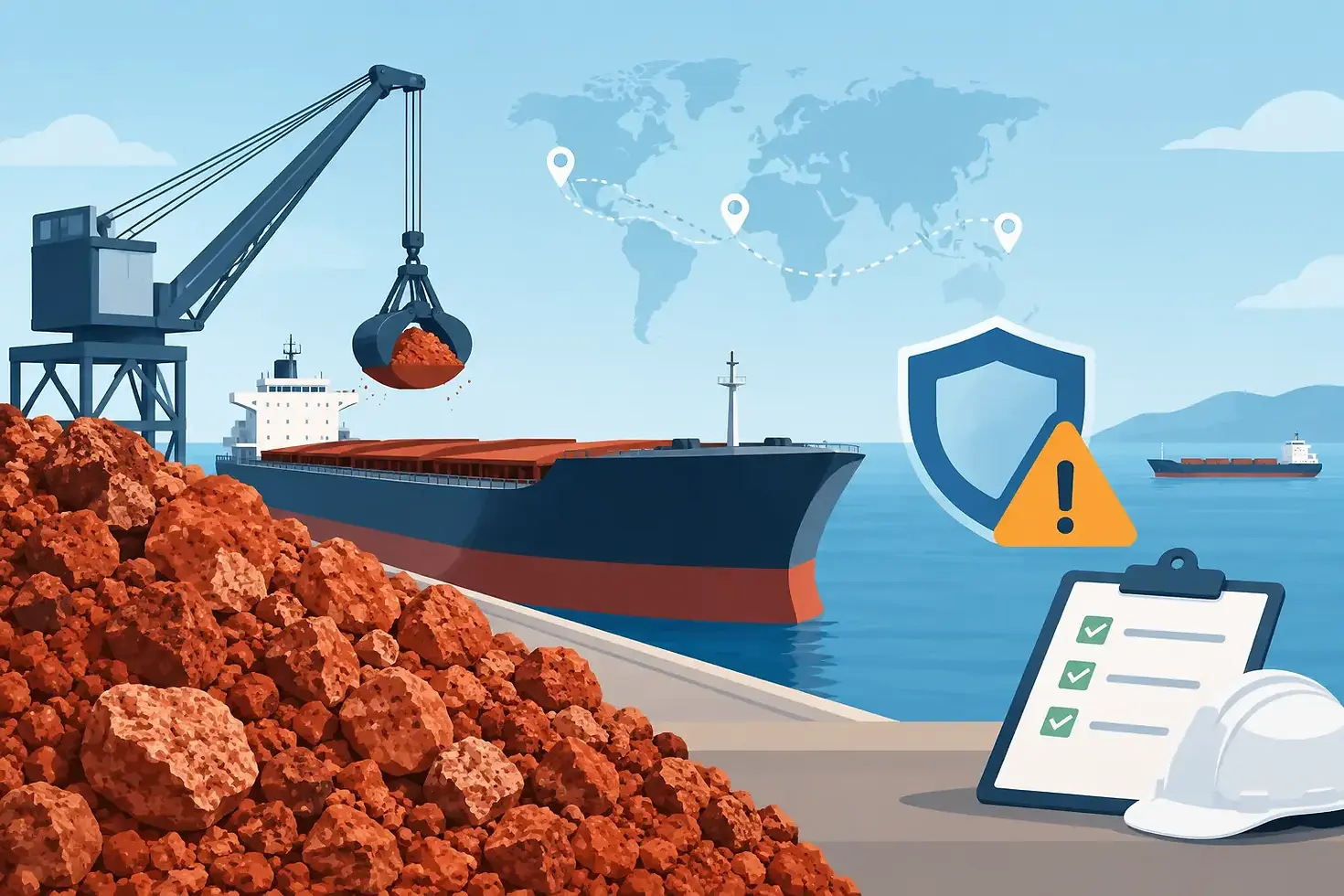
Logistics Risk Review for Bauxite Exports
A logistics risk review is not a compliance exercise performed after an incident. For a bauxite producer, it is a management discipline that protects production commitments from the mine to the vessel hold. Every disruption along that route can affect shipment schedules, product quality, workforce safety, customer confidence, and the economic value created for Guinea.
In large-scale mineral operations, risk rarely sits in one location. It moves across haul roads, stockyards, rail corridors, port interfaces, marine operations, contractor networks, and information flows. The purpose of a disciplined review is to identify where operational exposure is building, determine which controls are truly effective, and direct investment toward the constraints that can interrupt export continuity.
Why Logistics Risk Review Matters in Bauxite Operations
Bauxite logistics is defined by scale, timing, and interdependence. A delay in loading equipment, an unplanned restriction on a transport corridor, or a mismatch between stockpile availability and vessel nomination can quickly propagate across the entire value chain. When production runs at industrial capacity, small deviations can create material consequences.
The strongest logistics risk review connects operational detail to strategic outcomes. It does not simply record hazards. It asks whether the logistics system can continue to deliver safe, compliant, and predictable volumes under realistic operating conditions. This includes seasonal weather patterns, infrastructure capacity, equipment reliability, contractor performance, regulatory obligations, and the changing requirements of international customers.
For buyers and partners, this discipline provides evidence that supply reliability is being managed with the same seriousness as ore quality. For public authorities and local stakeholders, it demonstrates that industrial growth is supported by accountable planning, controlled operations, and attention to territorial impacts.
Start With the Full Mine-to-Port Flow
A useful review begins with a clear map of the physical and decision-making chain. The objective is not to create a static diagram, but to establish where material, equipment, people, approvals, and data must move without failure.
For bauxite exports, the flow commonly includes extraction, crushing or screening where applicable, loading, road or rail transport, stockpile management, port handling, barge or conveyor interfaces, vessel loading, documentation, and dispatch. Each handoff deserves scrutiny because handoffs often produce the least visible risks: unclear operating accountability, inconsistent inspection standards, delayed communication, or incomplete records.
The assessment should also recognize that critical dependencies extend beyond the mine site. Fuel availability, spare parts, skilled maintenance capability, telecommunications, customs processes, marine conditions, and access to qualified service providers can all influence the ability to meet a shipment window.
A risk is most useful when stated in operational terms. Rather than recording “transport disruption,” define the event, cause, and consequence: restricted road access during heavy rainfall may reduce hauling capacity below the level required to replenish port stockpiles, leading to delayed vessel loading. This clarity allows leaders to assign ownership and select controls that address the real exposure.
Separate Frequency From Impact
Not every risk merits the same response. A minor equipment issue may occur frequently but be resolved quickly through standard maintenance practices. A low-frequency port closure, by contrast, may have a far greater impact on customer commitments and cash flow. Both must be visible, but they should not receive the same treatment.
A practical assessment considers likelihood, operational consequence, safety consequence, environmental consequence, financial exposure, and recovery time. Recovery time is especially important in export logistics. A disruption that can be corrected within hours is fundamentally different from one that requires days of rescheduling, emergency mobilization, or vessel renegotiation.
The ranking should remain dynamic. A risk that is acceptable in a period of high stockpile availability may become critical when inventory is tight, weather conditions deteriorate, or multiple vessels are scheduled in close succession.
Test the Controls, Not Just the Plans
Policies and procedures matter, but a documented control is not necessarily an effective one. A mature logistics risk review tests whether controls are consistently applied in the field and whether they still match the operating environment.
For example, vehicle inspection protocols should be verified through maintenance records, inspection quality, defect closure times, and frontline observations. Traffic management plans should be assessed against actual route use, driver behavior, visibility conditions, fatigue controls, and emergency response access. At port level, the review should examine equipment availability, loading rates, sampling discipline, stockpile segregation, and coordination between terminal and marine teams.
This approach also reveals control gaps caused by growth. Infrastructure and procedures that were appropriate at one production level may become insufficient when fleet movements, loading cycles, or shipment frequency increase. Capacity expansion should therefore trigger a formal reassessment rather than an assumption that existing controls will scale automatically.
Protect Safety, Product Integrity, and Continuity Together
Safety, quality, and continuity are sometimes reviewed in separate programs. In practice, they are closely connected. A fatigued driver creates both a safety risk and a transport reliability risk. Poor stockpile management can compromise bauxite specifications and delay loading. Weak maintenance planning can increase emissions, equipment downtime, and schedule instability at the same time.
The most effective reviews identify these connections and avoid solving one problem by transferring risk elsewhere. Increasing haulage speed to recover a schedule, for instance, may raise the probability of incidents and accelerate asset wear. Building larger stockpiles can strengthen shipment resilience, but it may require stronger water management, dust controls, and material traceability.
Trade-offs should be explicit. Decision-makers need a clear view of the operational benefit, the residual risk, the cost of mitigation, and the consequences of delaying action. This is how risk management becomes a source of disciplined performance rather than a barrier to production.
Use Data to Detect Pressure Before Failure
Leading indicators are more valuable than post-incident reports because they show where pressure is accumulating. The right indicators vary by operation, but they often include equipment availability, unplanned downtime, maintenance backlog, road-condition inspections, queue times, loading rates, stockpile days of cover, near-miss trends, contractor compliance, and weather-related interruptions.
Data should be interpreted in context. A high equipment availability rate can conceal a growing maintenance backlog. A strong monthly loading result can be achieved through exceptional effort that is not sustainable over the next quarter. The review must therefore combine performance data with technical judgment from operations, maintenance, health and safety, environmental, logistics, and commercial teams.
Scenario testing adds further value. Management should ask what happens if a key loading asset becomes unavailable, rainfall exceeds normal assumptions, a transport route is temporarily constrained, or a vessel arrival changes at short notice. The goal is not to predict every event. It is to understand the operational limits, recovery options, escalation thresholds, and communication responsibilities before a disruption occurs.
Establish Clear Ownership and Escalation
Risk registers often lose value when ownership is vague. Each priority risk should have a named accountable leader, a defined control plan, measurable indicators, and a review frequency aligned with its severity. Operational teams should own the day-to-day controls, while senior leadership should remain responsible for removing structural barriers and approving material investments.
Escalation protocols are equally important. Teams need to know when an issue remains within normal operations and when it requires cross-functional intervention. A port constraint, for example, may require immediate coordination among mine planning, transport, maintenance, marine operations, commercial teams, and external partners. Delayed escalation can turn a manageable deviation into a missed shipment.
SMB’s integrated operating model illustrates why this governance matters. When extraction, infrastructure, transport, and export activities are connected by common performance objectives, logistics risk can be addressed across the value chain rather than at a single point of failure.
Make the Review a Decision Cycle
A logistics risk review delivers its value through action. Priority findings should lead to a clear decision: maintain an existing control, improve a process, invest in capacity or redundancy, adjust operating plans, strengthen a contractor requirement, or accept a defined residual exposure. Each decision needs a deadline and evidence of completion.
The review cycle should also reflect the operating calendar. Before the rainy season, attention may center on route resilience, drainage, fleet readiness, and stockpile strategy. Before periods of high shipment activity, the focus may shift toward port capacity, marine coordination, maintenance readiness, and customer communication. A quarterly review can provide strategic direction, but critical indicators may require daily or weekly attention.
For bauxite exporters serving global aluminum supply chains, dependable logistics is built through disciplined anticipation. The most valuable review is the one that gives teams enough visibility to act early, protect people and assets, and keep industrial commitments moving with confidence.


Commentaires